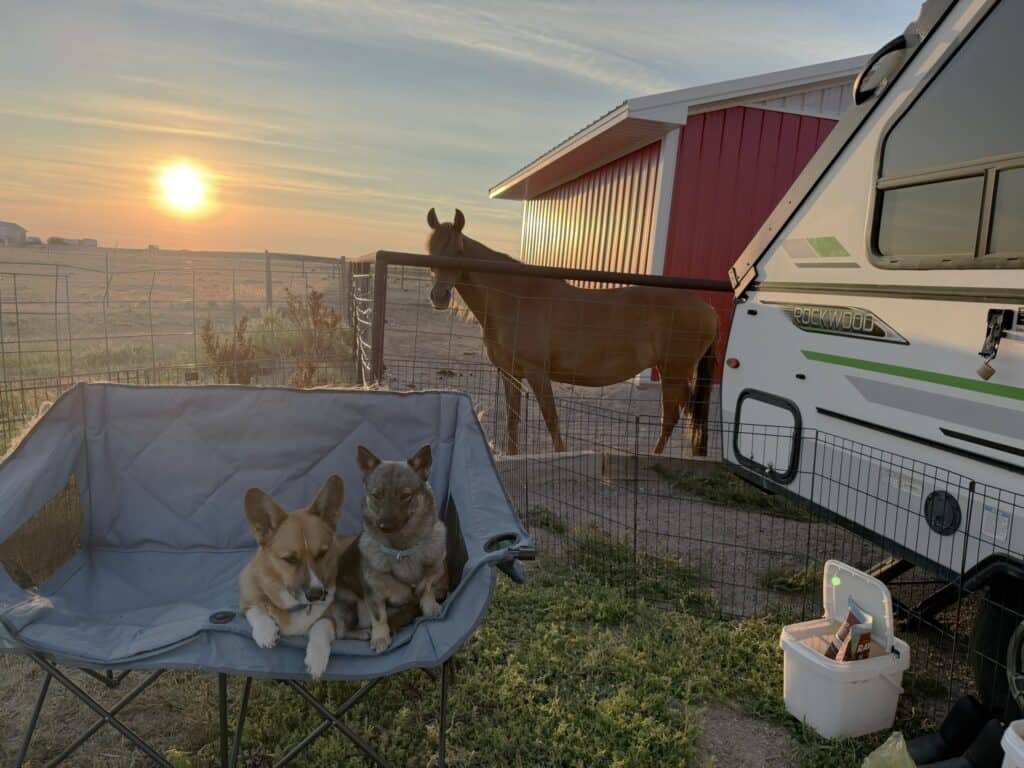
We were at a clinic in Wyoming this week. I’m not saying it was hot, but Mister wouldn’t move from the front of the air-conditioning vent. I watch the breeze waft hair off his body in a near-mystical golden cloud. The air conditioner is doing its best on a hundred-degree day. I compare it to my 1964 Volkswagen bug’s heater, which blew on my ankles like the dying gasp of an ant.
As always, the hardest part of giving a clinic is getting past my mailbox. You know this part. It practically takes as long to get ready to go as you will be gone. This time, I’m a little worried about the Herdables. My barn helper is used to the horses and Edgar Rice Burro, but now sheep and ducks, too. I updated her two hundred pages of notes and gave her a raise.
This Wyoming barn is my all-time favorite place for a clinic. It’s not just because they have the best RV spot ever, down by the barn. It’s because we truly put the horses first, and that means calming signals are the focus. Horses set our schedule. We surrender control before we start. Remarkably, we always finish by 5 PM.
This is also where Bailey, the Labrador who taught Jolene to like big black dogs, lives. Mister impolitely differs. He is comfortably bigoted toward dogs taller than him. Mister says, you would be too if they kept attacking you like off-leash commandos. Not even in hellish dog parks, but anywhere you’d least expect it. He says, no socializing for him. He prefers the air conditioner.
This year, there is a new rescue named Dudley. The last six months have been heaven, and he doesn’t know how he got so lucky. But he has been returned before, he can’t quite trust it. They would never take him back, but he doesn’t know that, so he tries too hard. I’m besotted.
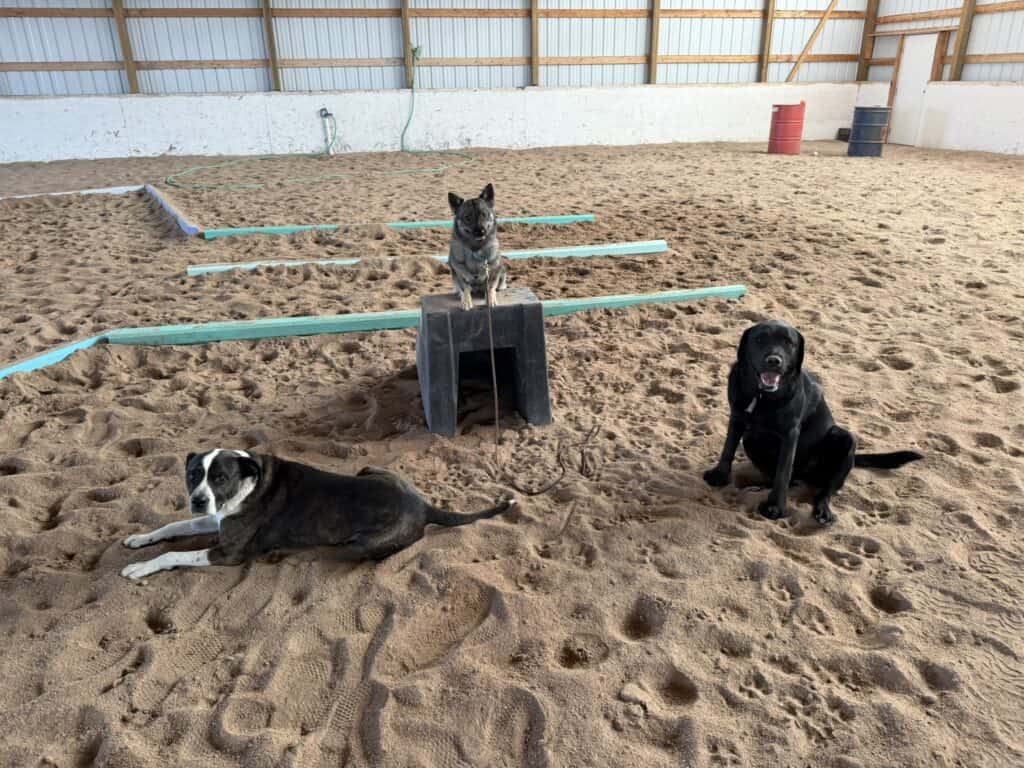
We take Jolene, Bailey, and Dudley to the indoor arena. Humans sip our cocktails and watch the calming signal conversation as we stroll, because just like horses, forward momentum is a release. Big dogs greet a bit louder than Jolene would like, so she claimed the space between my feet as a free zone. She tells them she’s nervous, they are gentle. We’ve made it to the mounting block at the far end. Yay, says Jolene. A height equalizer. She climbs up, but minutes later, they are all on the mounting block. Not her original plan.
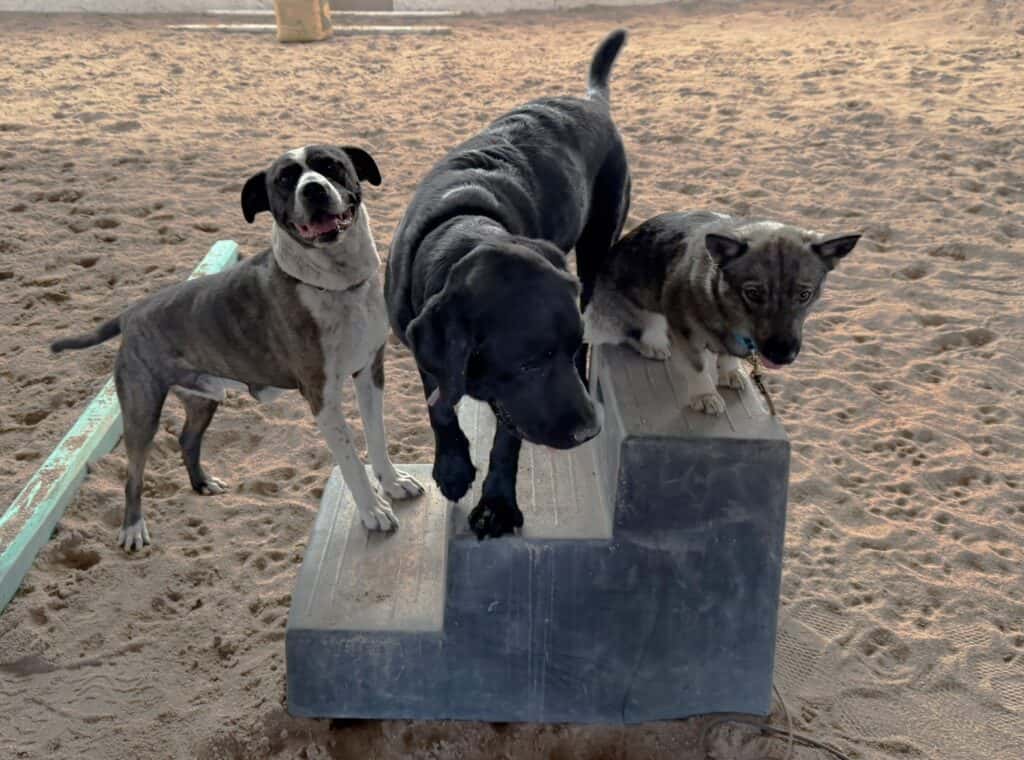
I took dozens of photos of the three dogs over the next days. In each one, Dudley is smiling at the camera like a weird uncle, when everybody else is squinty and backward. He just wants to be okay, and for the quadrillionth time, I think we don’t deserve dogs.
Then Bailey drops and does a play bow, but Dudley gets in the way. It’s what he is good at. Again, Bailey drops, and finally Jolene darts out and right back to my feet. A couple of false starts, and Jolene remembers she can outrun anybody. Now Bailey and Jolene are zooming, kicking up sand, and fishtailing on corners. Dudley flounders along behind them. Both of the girls’ ages don’t add up to his. Eventually, the big dogs get tired, and Jolene takes the throne again.
The clinic participants all trickle in, and the clinic starts the next morning. I know everyone this time, and we all agree on Affirmative Training, so we dive right in. We love what we’re doing — sharing horses and working together. The rides are forward and people are deeply interested. I’ve been on a steep learning curve about calming signals since 2012, but going deeper with Jolene in performance work is a master-class for me. Now the sheep and ducks, extreme prey is a fair term, have made my understanding click in a deeper way about horses. The thing about listening to calming signals that we all agree on is that you can’t unsee them.
The first day goes well. The horses were communicative, and we all did some processing. After we finish the day, Jolene and the big dogs meet again. This time they zoom right away. Back to the trailer where Mister is waiting for his dinner. Mister has always excelled at waiting in the trailer.
When we were here last year, Jolene was five months old and still Mister’s dog. When I gave Jolene to Mister, I knew the day would come when she would take the lead and switch allegiance to me. Mister has never aspired to public office and doesn’t take offense. Mister demurs because it was never about dominance. He says, being the object of Jolene’s attention is exhausting.
This year, it’s harder for Jolene to spend time away from me. She has taken up interior decorating. Her style mingles a covers askew, slept-in look with a nose print texture on the windows. Like me, she doesn’t touch a thing in the kitchen. But that’s only because I have portable fortress walls to keep Mister out while I’m gone. No punishment; we are all works in progress.
It’s my first full clinic since my hearing loss. I’d like to say I’ve adjusted well, but nope. My hearing aids only work if I’m plugged into a second device. Even then, I’m disoriented with no directional awareness. I hear nothing behind me. I’m already hyper-focused on horses and riders, but add the stress of trying to hear. Luckily, I’ve trained my eyes to listen.
I have my remote mic on the rider, so I can hear her voice. I also hear her breathing and if she praises her horse. It’s strangely intimate when I hear so little otherwise. The barn owner has a hearing loss as well and also has a remote mic. We trade them, and for the first time, we can have a simple conversation, even if we’re far away from each other. Can you imagine how wonderful that is?
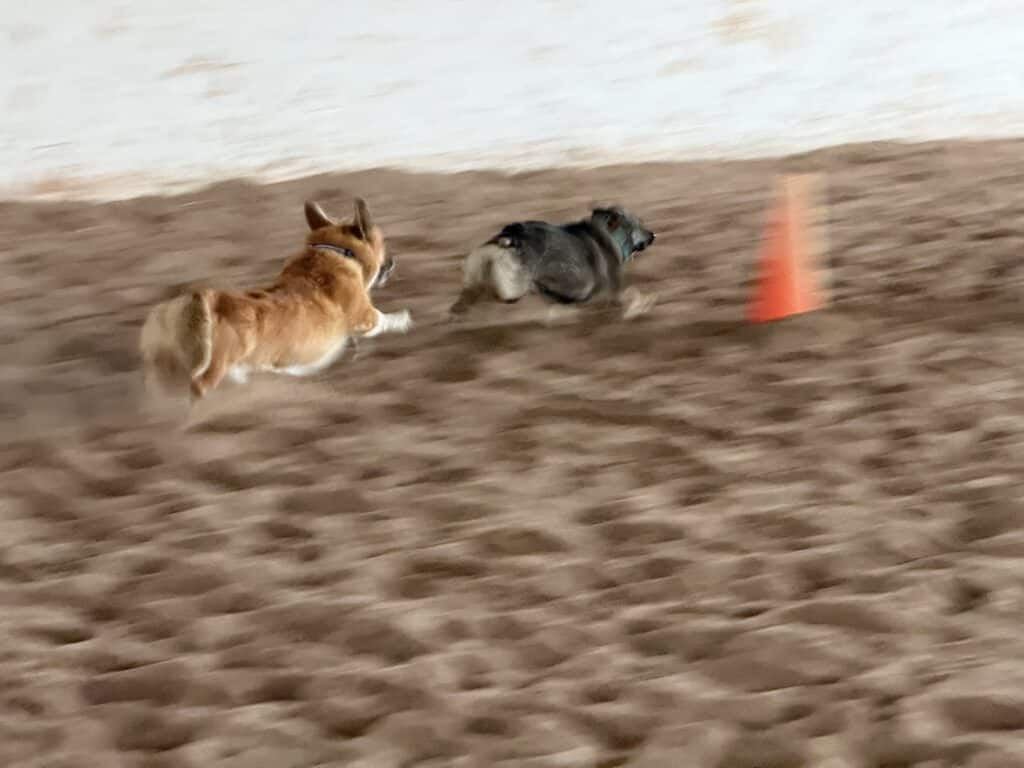
The day begins with Mister and Jolene zooming. Then hours of the horses taking us places we didn’t expect. Then the big dog zooms for Jolene. Perfect days.
Humans are as hard-wired as any other animal to notice what’s wrong in the picture. For prey animals, it’s looking for danger. The human version is to look for what’s not right. We constantly make judgments and draw conclusions, but if we don’t understand horses, they become more confused and untrusting. We are learning another way to train by listening to them.
Each clinic is unique and unpredictable. The human dynamics change, and working with horses always means spontaneity is required. Each day comes apart in wondrous ways, and the only reliable thing is a fabulous lunch. We venture into the unknowable, an inch at a time. Sometimes we make mistakes, but horses don’t care about that. Since control isn’t an option, we work like a herd, supporting each other. I trust this erratic process because in the end, horses always get us to where we need to be. For the quadrillionth time, I don’t think we deserve horses.
The end of each clinic, even after all these years, is always bittersweet. It’s hard to say goodbye. I let myself get attached to the horses and participants. I relive the best moments, sketch out new ideas for the next clinic. Mostly I celebrate the horses.
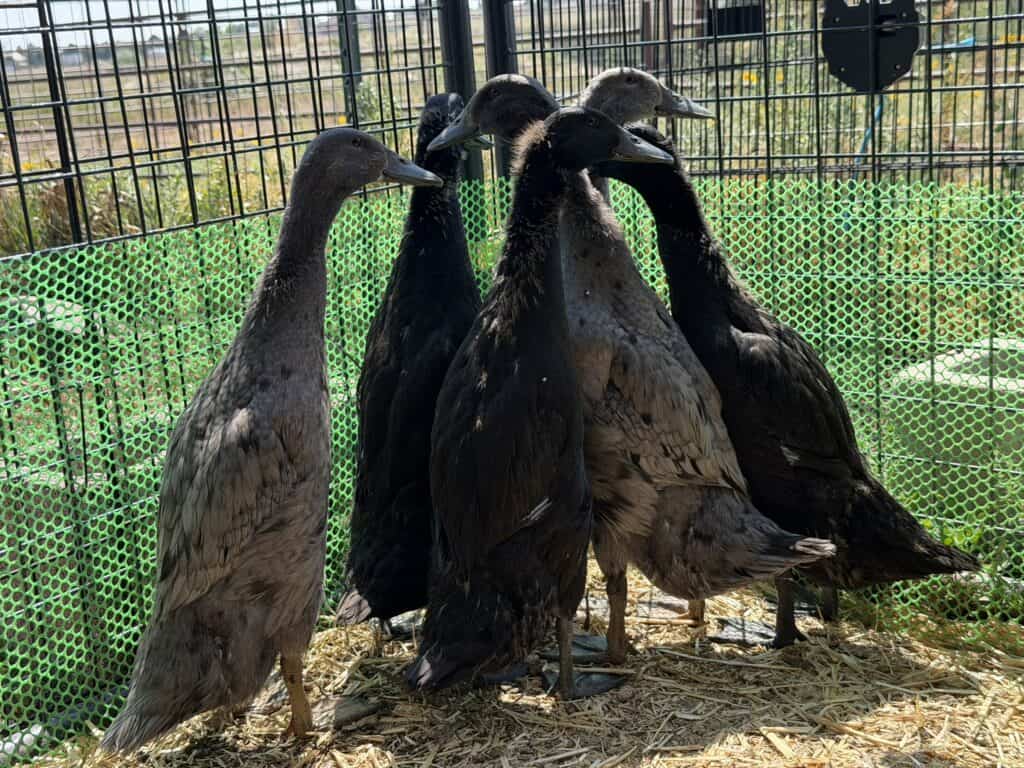
Then I hurry home to mine. My farm hasn’t burned down. The horizon has been gray with smoke all week. We’ve been lucky, even though it’s hard to feel good when there has been so much wildfire destruction. The horses and sheep look great, but the ducks are in a snit about the pea drought. They ignore me. I try to explain the concept of work and the cost of peas. They think peas fall from the sky. The ducks think I don’t deserve them either.
…
An audio version of this essay is available to subscribers who receive two podcasts a week on Substack.
Find Anna Blake and The Gray Mare Podcast on Substack or BlueSky social media. Contact me directly at annablake.com. #deletefacebook
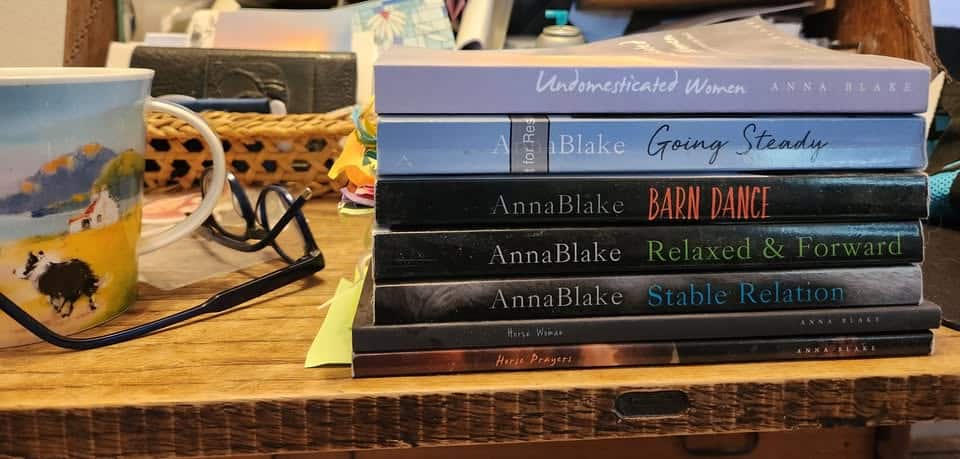
My books include three creative nonfiction books, two memoirs, and two poetry books. Available at all online booksellers, Amazon, Barnes and Noble, and signed copies from me. Please consider leaving a rating or review.
Join us at The Barn School, our social and equine educational site, with member sharing and our infamous Happy Hour. Everyone’s welcome. For specific horse training advice, search 1500 essays archived on my website. Want more? Become a sustaining member, a “Barnie.” Subscribe to our online group and join the best bunch of like-minded horse people anywhere.
Ride for a new brand. Find our Relaxed & Forward and Undomesticated Women swag at Zazzle.
Women Aging Cantankerously

Oh Gosh, I loved everything about this post. So glad you are still working with horses. I agree, in the end they get us to where we need to be. Good luck winning over the ducks. Gonna take a lot of peas.
I am still working with horses! and it’s still my only income. And I’ve written about horsess every week for 15 years. I’ve just added dogs and aging. Because my life has… Thanks for reading along and you are so right about those peas!
As always, thanks, Anna. I needed something to make me smile! 💛
Thanks, Tricia. That’s my hope.
I always look forward to your Friday morning essays. This was a good one ! I like that you are taking us along on your adventures by writing and sharing here. That photo of Jolene on the mounting block alone and the 2 other dogs to the side is just sooo good. How did you manage to capture that I wonder, and Mister and Jolene zooming about is equally fun.
Sarah, my friend, thank you for reading along for years, even as I slide into an adjacent subject. As for any photographic skill, I just stand around and watch. Jolene makes it easy. She might be Gusto’s sister from another mother.
“Like me, she doesn’t touch a thing in the kitchen” teehee😁 I used to say I’m happy to clean dishes if someone else does the cooking 🤔
When modern technology works it is a real blessing, glad you had a time when it worked.
Dear Dudley❤️
Thanks, Annie. Technology is my best friend, between work and hearing loss. And yes, he is so dear.
Somewhere I have a picture of my dog, Sugar, a hound/shepherd mix, Laurie(friend) dog, McKenzie, a King Charles Cavalier Spaniel, and Cindy’s dog, Kelly, shepherd? mix all standing side by side on the end of a trailer. We were at Brookfield, state park, with our horses – staying in a tent for a week. It was great. Dogs loved it – horses? not sure – no turnout – just covered stalls. But the trails and the rides? Anyhow, the dog picture – all 3 are gone now of course. But they were buddies.
The mounting block pic reminded me.
Your clinics always sound so enjoyable – whether someone is a horse person or not. And the zoomies!!
I think the clinics are enjoyable without a horse… but your trip sounds wonderful. That’s what I love, too. Just getting away with my friends. All of them. Bless our dogs, here and there. Thanks, Maggie