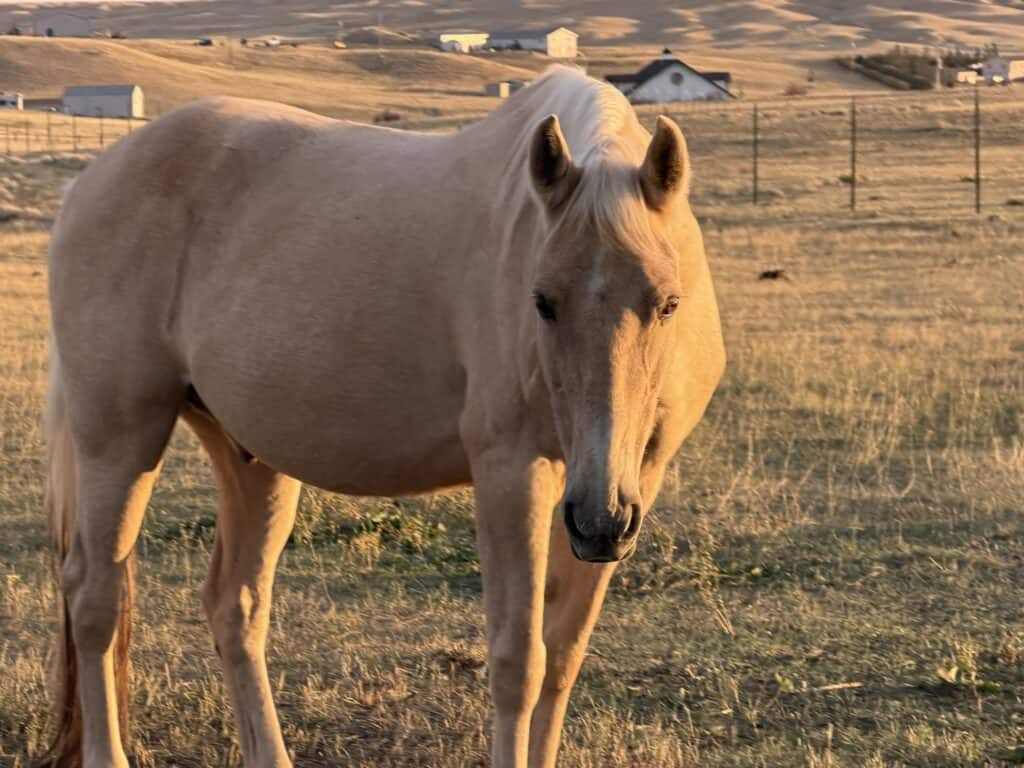
The buttery glow of a palomino at sunrise. But so much more. It’s his obvious intelligence. His ability to have total awareness of his environment while focusing on us. His choice to engage with us, when his instincts might be wary. The miracle of survival despite his fragility. It’s enough to steal my breath, like the first time I saw a horse.
But the horizontal early light also reveals hard lines of light and shadow. Part of him is sunlight clarity, and part is never quite in plain view. The instinct to hide their weakness is a survival skill, even at their home farm. Internal questions of confidence and resistance. Secrets dealing with memory and emotion. The understated part makes the horse unique. It’s these least visible parts that matter most.
Mister says, I thought you were writing about dogs now. I say I’ll get to him and Jolene. He answers with a flat, humorless stare. Mister, whose name is actually on the title of the Rollin’ Rancho, says he’s working, too. No one dogsplains quite like him.
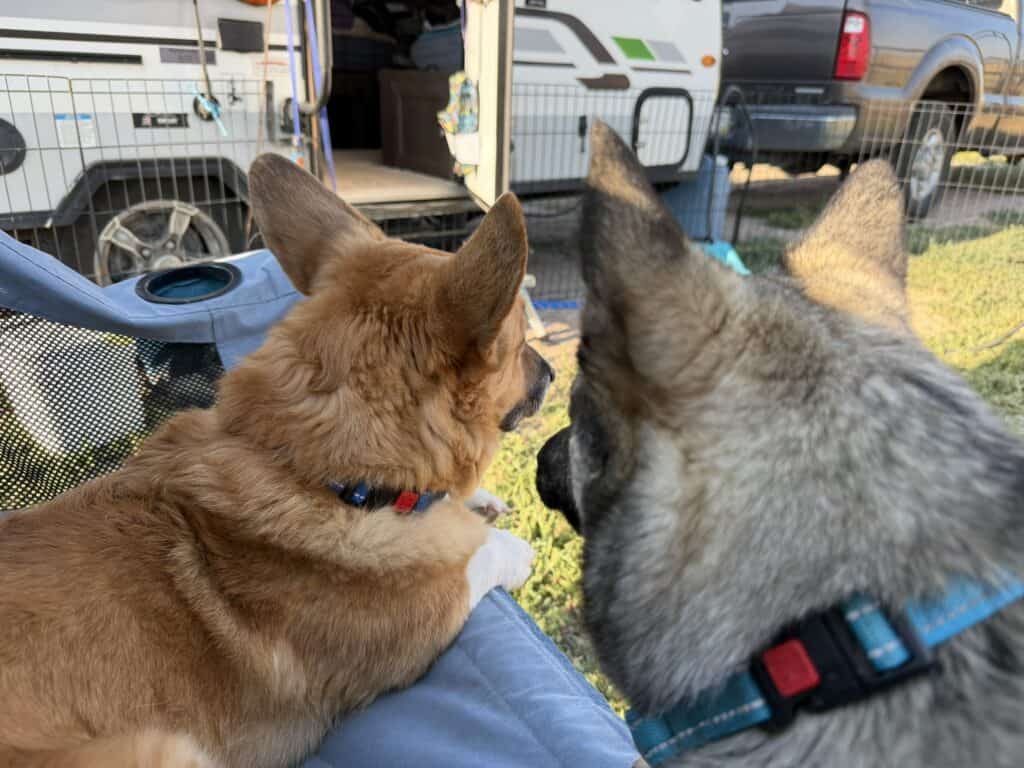
I’m just home from the last clinic of 2026. Just over the Wyoming border, a three-hour drive that has left me with jet lag. I won’t recover quickly. I’ve tried to describe these intensives but failed. I haven’t given up.
Start here: Most of us have a glitch in how we talk about horses. Oh, we educate ourselves and discuss their management, health concerns, training issues. While standing in their pen, or saddle to saddle, we yammer endlessly, guessing what they are thinking or why they do that thing. We hypothesize their past and dream their future. There’s just one thing we leave out in these long heartfelt conversations.
The actual horse, who is standing right in front of us. For all our passion and commitment, we don’t let them speak for themselves. I don’t mean a psychic translation. We take away their voice by not spending the time and being still enough to listen to the real-time conversation.
We think we listen to horses, but too often we put human words in their mouth. It makes sense when you consider that, for all our good intentions, no one tells us what we are supposed to be listening for. Affirmative training combines listening to calming signals, understanding equine brain science, and the art of applying both to the ancient tradition of dressage.
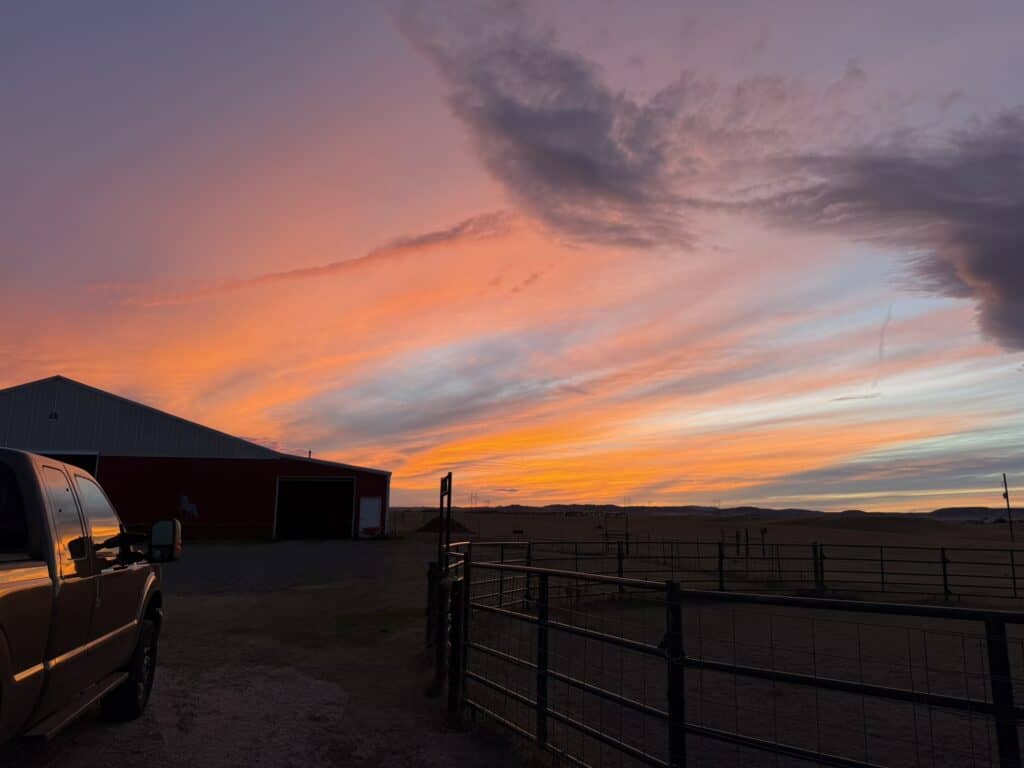
We’re at Joni’s barn outside of Cheyenne. It’s the only barn I go to these days. I’m tired of leaving my animals and spending months on the road, coming to barns by invitation. Now it’s your turn to travel. Besides, Joni shares her horses. Do you know how rare that is?
Part of the group are local folks who ride with Joni, and part are my clients, mostly from The Barn School(opens in new tab). It’s a diverse group rich in years and experience, with a fierce passion to get this right for horses. There are new people and old friends because some attend year after year. After the first day, I can’t tell them apart.
Jolene says, can we play now? First thing every morning, we head to the pasture, which has a few kinds of poop, varmint holes, and very sniffy places. Mister does a leg lift workout. Jolene does “native” scent work.
Each clinic day begins with the participants haltering the herd with awareness, bringing them into the indoor arena, and turning them loose. Some horses roll, some wander, some are curious. We watch and listen. There may be announcements, questions, and some planning, but we are all sitting, facing the arena. We watch their calming signals until they are ready.
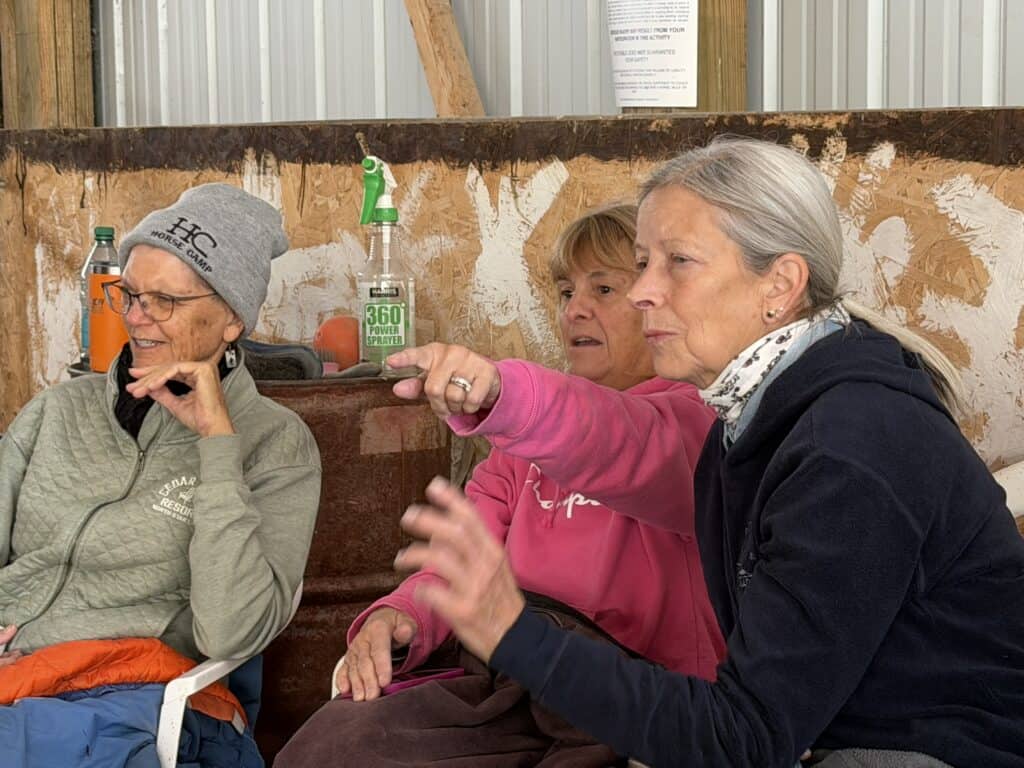
The format of the clinic isn’t like anywhere else. There is a faint outline of a schedule, but we go in horse time. Most of the horses are in western saddles. Some are in bitless bridles, some with no headstall. Everyone has a neckring. The horses are unpredictable; the art is how language and listening can be applied in the moment.
Each horse and participant spend as much time tacking up as needed. This goes slowly because we want consent. Then I give a lesson that’s a combination of dressage fundamentals, what the participant wants to work on, combined with what the horse needs. It’s forward movement and the finesse of steering with seat and legs. It’s my hope that every participant gets all the lessons.
I don’t measure time, because a lesson is not about an hour, it’s about a change in the horse and rider. The lessons last until the horse is brilliant and the rider wants more. Then we stop, release the horse from his tack, and let him have the arena to process. Allowing the horse that moment is just as crucial for the human. We both learn in hindsight.
Then, change happens. One day a horse might be a little off, and the next day have a lovely spark and forward energy. Each rider gets a different answer from the same horses. No one ever knows what will happen. Just the way it should be.
At noon we turn out the horses and break for lunch. We are never late. Half of us come for Bill’s lunches. Afterward, we halter the horses and begin again. Somehow, it all falls into place, and we finish on time.
The arena goes to the dogs after 5 PM. Bill meets us with custom cocktails. Jolene pretends to be shy for a minute and then attacks Bailey and Dudley. As much as an eighteen-pound dog can. She skitters under chairs that the big dogs can’t follow, stops to spit sand, and bolts away again. It doesn’t last long. This trip, Mister tried to join us. He sat in a chair making judgments, growling disapproval at anyone who came close. One day at a time, Jolene says. She is working on his social skills.
Mister is more anxious this trip. He broke out of our yard twice, running like a bullet train with temporary deafness and total amnesia. Mister runs because he has anxiety, then remembers that running makes him anxious. He is certain he’s in trouble, but that was before me. I tell him he’s the best boy. I praise him because nothing else works.
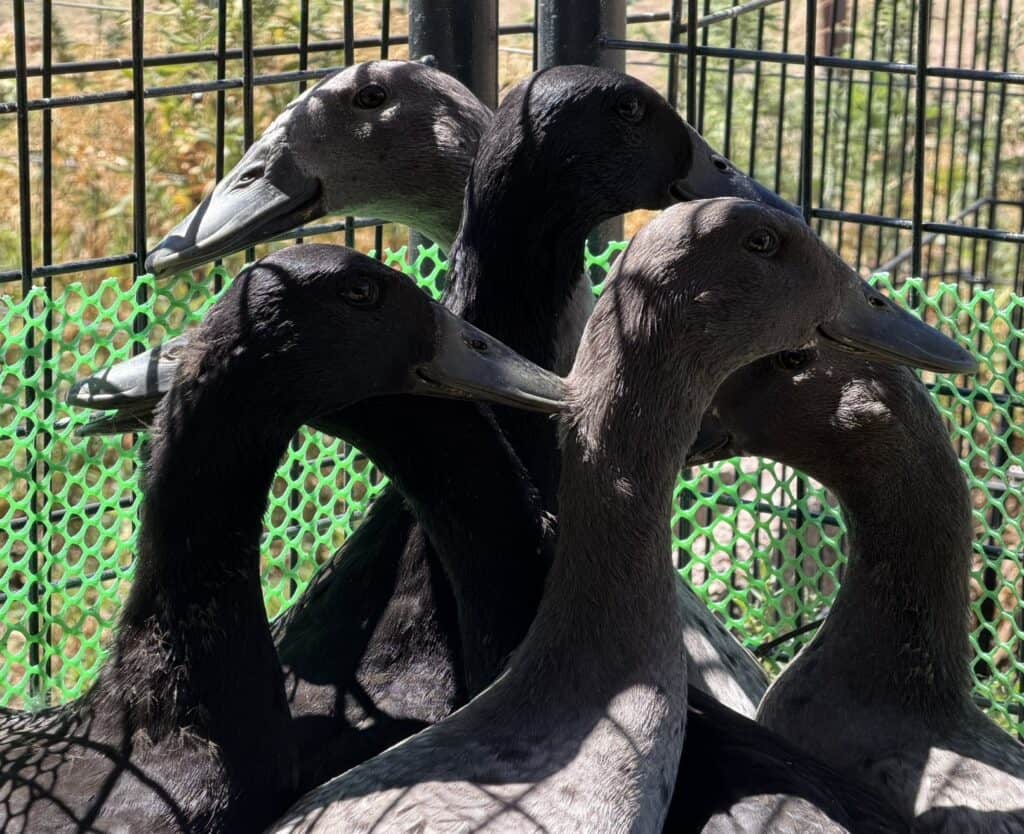
Jolene begins to miss home, too. She tosses the trailer; call it a calming signal. It’s been a busy time for introverts like us. Traveling since the first of the month, and she is getting a bit clingy. Who knows what the sheep are up to. Not to mention the ducks are old enough to herd now. Jolene says, can we go, please?
On the last day, I want all the participants to get their best ride. Horses are as unpredictable that day as any other. Some horses waltz with forward energy. Others appear to regress. The clinic days have been as long for them as for us. Some horses get a trailer ride twice each day. Others are in strange pens. Joni’s horses get haltered by strangers who stare like coyotes. And it’s about them. It should be obvious, but Joni and I mean it when we say horses first.
I am horrendously bad at saying goodbye. I get weepy, already missing the total immersion shared with women who truly want the best. I want to hold this last day, squeeze every drop out.
Returning to the trailer, the dogs greet me. I take the corsets off my feet, and my hearing loss makes my back hurt. Digging into lunch leftovers, better than anything I could cook, I play a rerun of the day. What could I improve?
We’ve talked about next year. We are all people of a certain age. Some of the horses are in their mid-twenties. Who knows how many years we will be able to continue? We are each fine until the day we are not. It breaks my heart. It’s taken my lifetime to gain this understanding of horses.
A special thank you to everyone who has come to this very wonderful ranch, my home away from home. So grateful to this herd of brilliant horses, and to Joni and Bill, Bailey and Dudley, who open their ranch to us.
Most of all, I’m swimming in over-my-head gratitude for all that horses and dogs have given me every day, if only I listen.
…
An audio version of this essay is available to subscribers who receive two podcasts a week on Substack.
Find Anna Blake and The Gray Mare Podcast on Substack(opens in new tab) or BlueSky social media. Contact me directly at annablake.com(opens in new tab). #deletefacebook
My books include three creative nonfiction books, two memoirs, and two poetry books. Available at all online booksellers, Amazon, Barnes and Noble, and signed copies from me. Please consider leaving a rating or review.
Join us at The Barn School, (opens in new tab) our social and equine educational site, with member sharing and our infamous Happy Hour. Everyone’s welcome. For specific horse training advice, search 1500 essays archived on my website. Want more? Become a sustaining member, a “Barnie.(opens in new tab)” Subscribe to our online group and join the best bunch of like-minded horse people anywhere.
Ride for a new brand. Find our Relaxed & Forward and Undomesticated Women swag at Zazzle.

Brava. Wish I were there.
I loved you at that Texas day, thanks, Sherry.
This is yet again a wonderful post. I learn so much and appreciate your lifelong passion for animals. I’m back feeding our 17 horses after 3 and a half months of recovery from a serious fall at home. I’m 79 now and hearing impaired but determined to keep my routine. Over the years I have noticed how important it is to watch and listen and not impose our will on these magnificent creatures who have retired after years of being “controlled ” for racing. Quiet and gentle is the way to go with our guys.
May I post this on Twitter(it will always be Twitter to me)? I follow other rescue/retirement horse farms and your wisdom would be invaluable to share.
Thank you for all you do.
Thank you back, Pat. Glad to hear you are mending. It’s a balance, this work that heals us and the danger there as well. I’d be flattered if you shared it. I appreciate it.
Anna, it’s been a complicated last 6 months health wise. I have been both distracted and hyper aware around all the living things around me. I can say with confidence that the times I stopped and really listened, I truly felt a sense of peace. Though it has been difficult to keep up with my cherished pursuit of your writings, when I do, it’s an absolute tonic. You are a constant reminder of where the real value lies in life. THANK YOU!
Oh, Laurie. I hope you are on the mend and doing well now. Please take the best care.
Wonderful essay, thank you for sharing. And now you get to luxuriate in the knowledge that you can stay home for a while!
Thanks, Shaste. It’s good to be home again.
A wonderful love letter, the finest.
I love that take on it. Thanks Annie.
It’s been a rough little over a week, I had Axel put to sleep a week ago Thursday. The worst was having to make the decision and the days before and after. Heck we’ve all been there before many times. But never does it get easier or less heart-wrenching.
The pictures of the gals at your clinic remind me of the bunch that I hung with at Chico’s barn.
Good post, Anna – I’m catching up – still have this week’s post to read.
Thanks, Maggie. Keep breathing. Axel deserves mourning and I’ll miss him with you. Take care.