Road trips have a feeling of being unstuck anyway, but this trip to the land of my people was like slingshot time travel. Glancing at a cloud, a memory starts foggy. Wait for the shy, buried parts to emerge. But then all the memories explode straight at you. Both slow motion and at blinding speed. Go beyond the stories you’ve heard all your life and see with fresh adult eyes. Even as you know it’s all in the wind. Road trips are always surreal, but this was whiplash.
We turned west and crossed into North Dakota. My parents grew up here. They married after WWII, and when I was one, moved to Minnesota and eventually Washington. They were a strange species that left their tribe to raise their young and didn’t return until we left the nest. I can count the times we saw relatives on one hand, and most of those were before fourth grade. My parents raised me to think North Dakota was home, but we didn’t visit there. I thought it was because we couldn’t afford it.
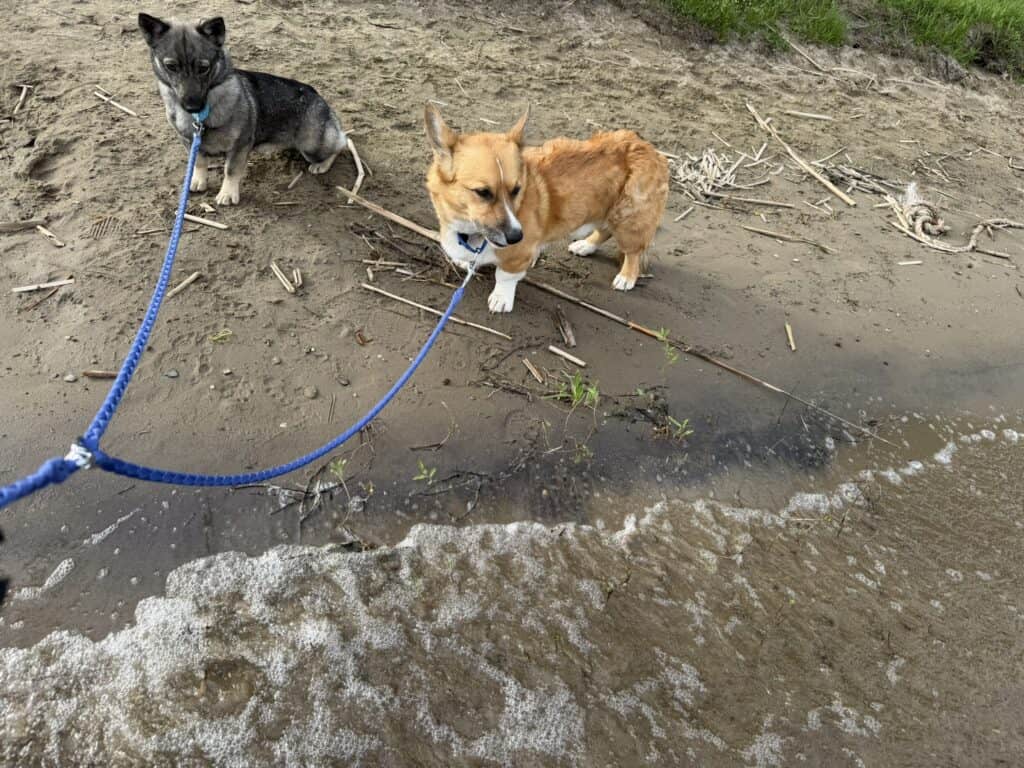
Few campgrounds up here, but we settled into Icelandic State Park for two nights. It’s in a forest with a lake and the most privacy anywhere we’ve ever stayed. We set up and took a walk to the lake so the dogs could watch me wade. I am a woman who rates the pleasure of my feet in cold water right up there with a full body massage. The dogs, not so much.
In the morning, I unhooked the trailer so we could travel light. We took two-lane back roads that were straight and flat, between fields that spread to the horizon. The only traffic was large trucks hauling farm equipment that looked like giant mechanical dinosaurs. The sort that ordinary farmers can’t afford. There was no livestock, no animals at all. All the small farms were gone. The treed corners were still there, but grain storage silos had replaced the family homes. Google says this is the highest-producing canola and wheat county in the country.
The first stop was the Hannah Cemetery, which is close enough to the border that my iPhone welcomed me to Canada. I worried because my GPS couldn’t find it. The cemetery has no sign either, but it was the only patch of grass and trees in miles of fields. I turned in, and to show my good manners, left the dogs in the car. Many of the graves were from the early 1800s, and many were of children.
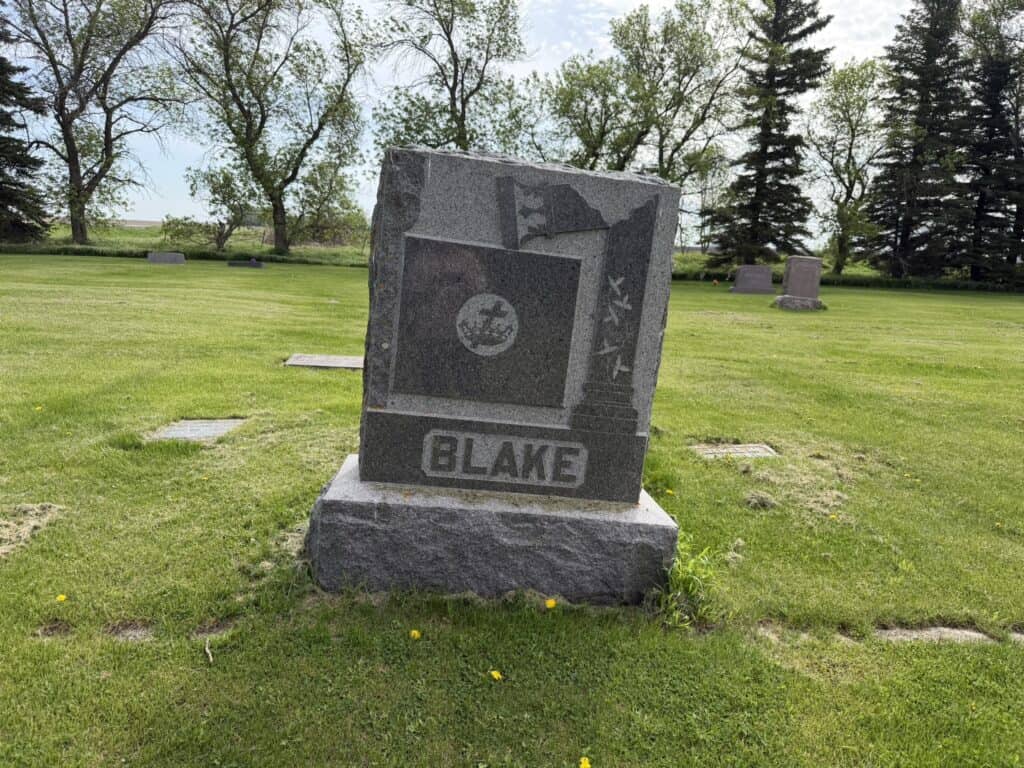
Finally, I found the marker with my name on it. My name because I have never changed it. That’s how I lost track of the female side of the family, off buried with their husband’s people, vanished from their own. Behind the huge gravestone were smaller stones for my father’s parents and his two brothers and their wives. My parents weren’t there. Weren’t there?
Barely a breeze and totally silent, I kept walking and reading headstones. Finally, I found my parents. They couldn’t be any farther from the family plot and still be in the same cemetery. How did I feel? It was the first time I’d seen their grave. I took a breath and felt around myself for feelings. I spent months helping each of them pass, there when they needed me. I waited for the emotions to scream and clutch at me with their boney fingers. It didn’t happen. I did a full body search, why wasn’t I feeling miserable? Is it wrong to say I’m oddly grateful for the time we had at the end.. The only good thing about cancer is that it gave me time to make peace with our lives together. No regrets, no grudges.
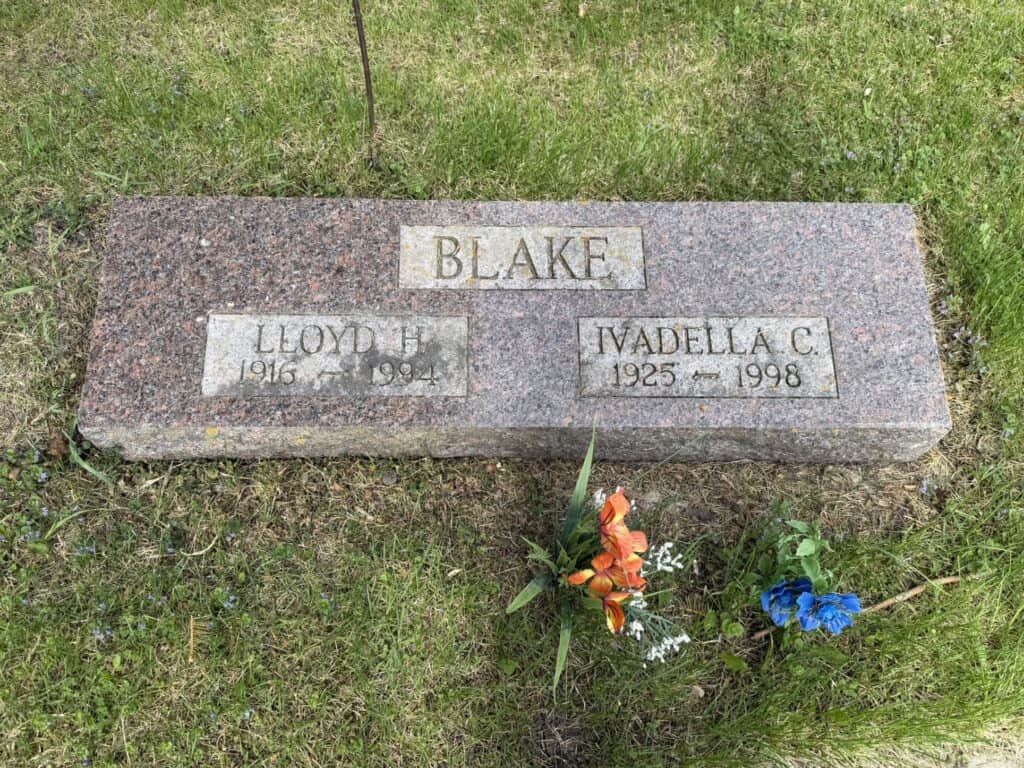
I don’t know who put the plastic flowers by their marker. Mom loved fake flowers for their, dare I say it, eternal nature.
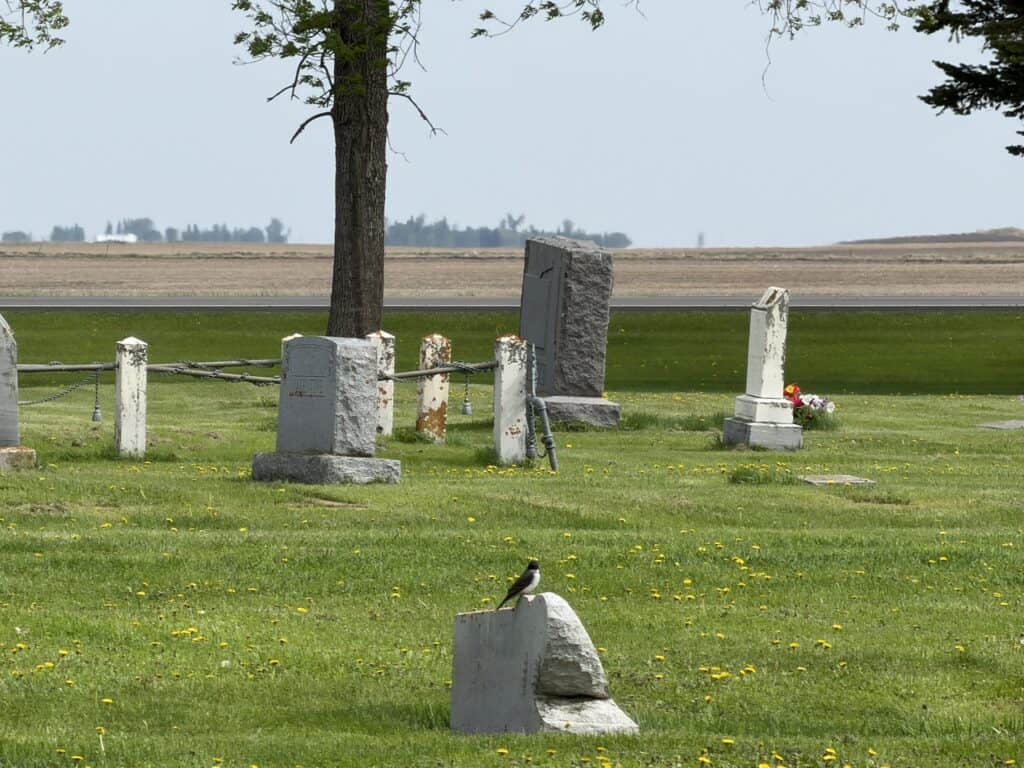
I looked back toward the family plot, our family dynamic in plain view. Like everyone in the county didn’t know my father didn’t get along with his father, and it trickled down to his relationship with me. In our family, the women were silent; the men were prone to rage and anger. How did he feel, knowing that his father excluded him in death as he had in life? My mother, out in limbo with him. Why would they choose to be buried here? As I gazed across to the Blake headstone, a bird sang to the heavens. How much unresolved pain lies buried in cemeteries? How many generations of feuding families? Grateful again for those decades of therapy and for knowing that I would not be back. My parents are at rest close to a tree, just feet from an ocean of wheat. It was peaceful here. I’m not sure either of them knew that in life.
Grandpa Blake was a horse trader and a farmer. Wealthy by comparison. The last time I saw him, he was on his deathbed. He had skin cancer and looked like a terrifying, monstrous reptile. I have another Mohs surgery next week. Afterward, Grandma Blake gave me a jelly glass of the sublime delicacy, canned apricot juice. She did not trust me with her depression glass, but it was the most exotic thing I’d ever seen. I collected it as an adult. The glass is over a hundred years old now, but antiques are out of style. I found this out while trying to raise funds to publish a book. Depression glass has aged out of value, they said. No longer collectible.
From the Hannah Cemetery, I drove to the town of Wales, population eight. Back in the day, it had a population of 150, but that didn’t count the dozens of families on the surrounding farms that came to town for church and groceries, and a drink sometimes. Now it looked like a set from a post-apocalyptic movie. There were houses the color of ash. Other houses more recently abandoned. Rusty cars and broken windows. One corner of town seemed alive with a long row of extra-huge metal grain silos, with acres of open ground all around. A shipping center in a town with no gas or food.
I located the main street of Wales, a dirt road as it had always been. I found bricks that used to be the school. From there, I could locate the lot where Grandmother Uhrich had a small house with no indoor plumbing. My Blake grandparents had the wealthiest house in town, but both houses were razed, along with the churches and bars. I’d seen this level of living before, but it was on reservation land.
We’ve all heard about it on the news. Farm consolidation is a sanitary term for losing a family home. Large operations hollow out rural communities. Local businesses fail, and kids move away for opportunities. I had heard stories over the years, relatives losing their farms as we had. There was no future. I didn’t expect how it would feel to be there on a remote cusp of world change. In three generations, it’s unrecognizable. Even so, painfully personal.
My Uhrich forbears were in a cemetery a bit east, but I didn’t have the heart to go. Instead, I headed back to camp, pulling over when dinosaurs passed. Mister squints and lets out a big sigh. He’s right. I was feeling prehistoric, like I’d seen all the destruction I could stand. Unlike around my farm where the town is encroaching, this place is on life support.
In Langdon, I pulled into the Dairy Queen for a brain freeze. Straight across the street was the Maple Manor Care Center. I recognized the name from several obituaries. Both my grandmothers died there, and a few aunts. So that’s the landmark, my only legacy still standing, and as close to a family home as I have. Ironic, Mister says.
Returning Sunday night to the state park, we found it totally empty. We were the only camper there. Alone in the woods with that bear. But all I could think about was a family that I didn’t know. A family that didn’t value family. I was raised that way. To love the land more. I hope I can hold on to mine. Land endures. “It’s the land, Katie Scarlet.”
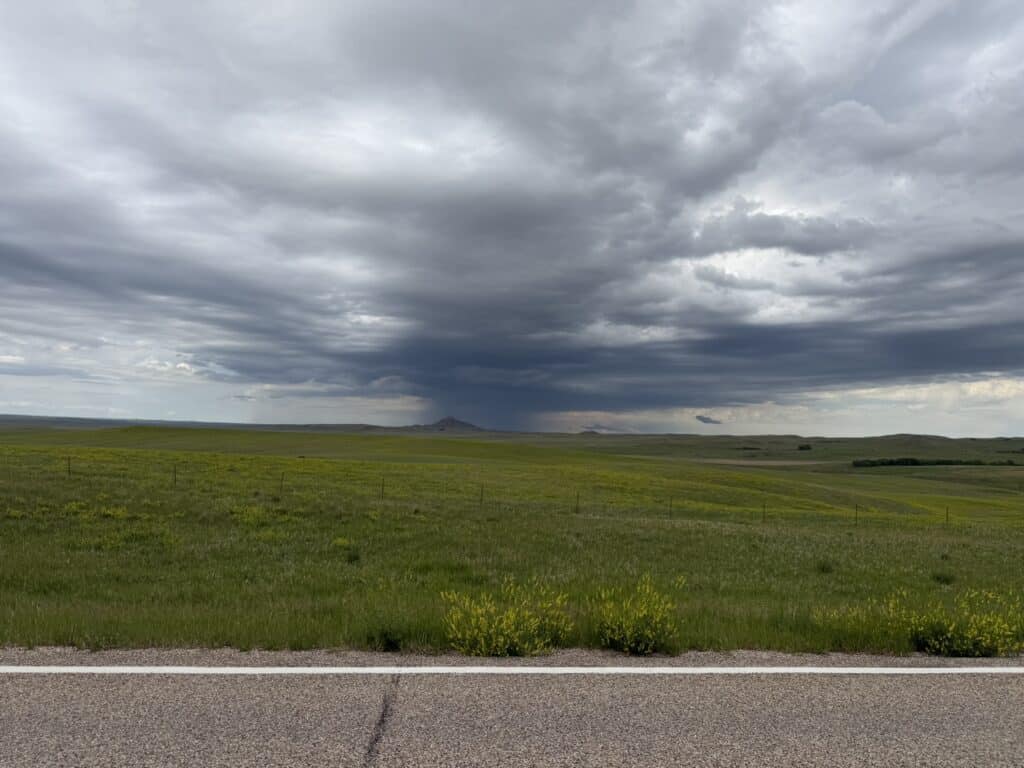
In the morning, we headed toward Sturgis, the first populated area we’d seen in three days. I hoped Jolene wouldn’t wake up. These are her people. Harley riders are the closest thing we have to Vikings. If I’d gotten a male puppy, I would’ve named him Sturgis, in the old Norse meaning. Jolene is close enough. The name of a woman who doesn’t play by the rules. Someone told me that Jolene was not a good name. The woman in the song was no one’s idea of a feminist hero, she told me, as if I did not know the earworm lyrics by heart. Just to be clear, my Jolene will steal your man, your kids, your dogs and leave you singing along.
One day, I will tell Jolene about trading t-shirts with a biker at a gas pump in Wyoming. I got his worn Harley t-shirt, almost like a scalp. He got a peek and a peach-colored t-shirt from a lesbian bookstore. I clearly won the trade. Now I’m pulling an RV. The bikers passed me in a cloud of thunder, their gray hair flying. These guys are old. Yeah, they’re my age.
The horizons are just as far away, but now turning into huge open prairies for cattle. Moving from farming to ranching. Most of the trip has been on patched two-lane roads, 65 mph. It shakes up the trailer, but you see so little from the freeway. This trip was an American history lesson from start to finish. Mister says, absurdity is the norm. Jolene says, you would know.
Dawn in Lusk, Wyoming, we’ll be home tonight. Jolene perches outside to guard the camp while Mister and I rub our crusty eyes and squint at the new day. I can only think about the dead for so long until an eighteen-pound soprano toad barks and I’m slingshotted back to reality.
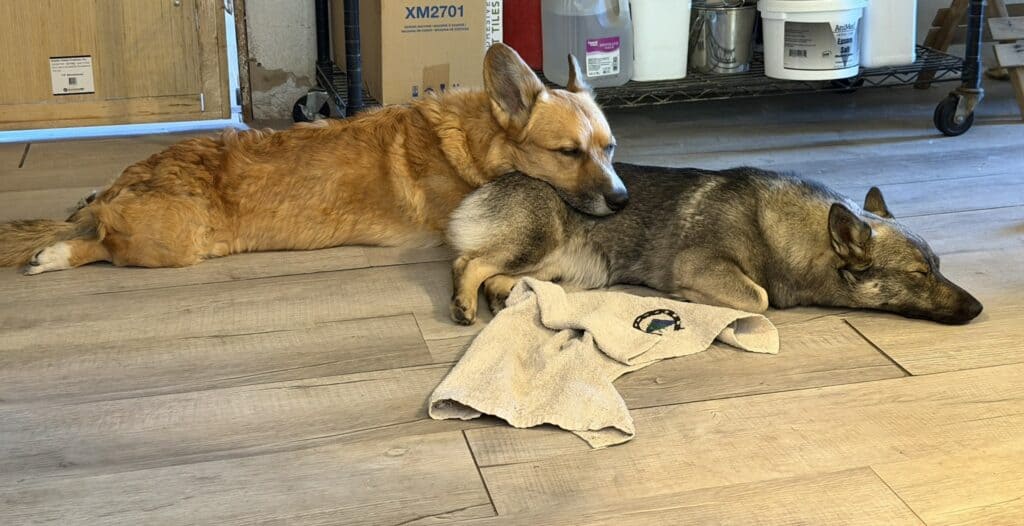
Everything turns to dust, I explain to the dogs. But don’t we all eventually become irrelevant in the face of what passes for progress? Mister says, speak for yourself. Jolene says, let’s run as fast as we can. Then, let’s sleep in a pile.
(Here is Part One in case you missed it.)
…
An audio version of this essay is available to subscribers who receive two podcasts a week on Substack.
Find Anna Blake and The Gray Mare Podcast on Substack or BlueSky social media. Contact me directly at annablake.com. #deletefacebook
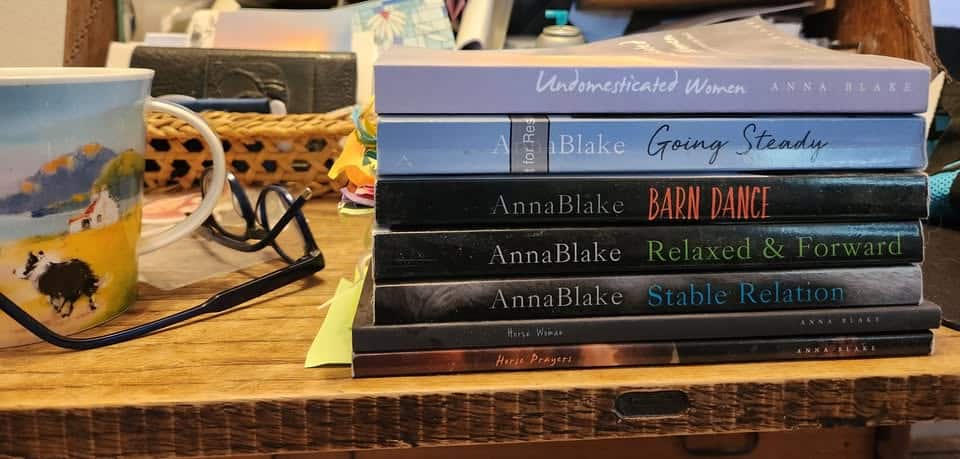
My books include three creative nonfiction books, two memoirs, and two poetry books. Available at all online booksellers, Amazon, Barnes and Noble, and signed copies from me. Please consider leaving a rating or review.
Join us at The Barn School, our social and equine educational site, with member sharing and our infamous Happy Hour. Everyone’s welcome. For specific horse training advice, search 1500 essays archived on my website. Want more? Become a sustaining member, a “Barnie.” Subscribe to our online group and join the best bunch of like-minded horse people anywhere.
Ride for a new brand. Find our Relaxed & Forward and Undomesticated Women swag at Zazzle.
Women Aging Cantankerously

This was amazing, thank you for sharing. It’s hard to believe places of such emptiness exist when in the populated places we’re elbowing for room.
Wonderful writing as always.
Isn’t it? In these last roadtrip years, the vast open empty land is astonishing. Thanks, Shaste.
I do love your posts. I think of my parents’ graves that I have seen a few times, in a beautiful old cemetery full of trees near the Susquehanna River. And I think of the number of small farms that have disappeared over the last decades, the number rising rapidly as the current administration does everything it can to give more and more money and power to the huge corporations who care nothing for the land or the people who once lived there. Someday, somehow, long after I am just dust somewhere, the land will come back and the farmers will return. I must believe that!
I’m sure that Mister and Jolene continue to remind you of what is important in the present. That is the great blessing of our pets! Including even my unfriendly cat Opie.
Do you know this poem? It is one of my favorites. He and his partner who was dying of AIDs adopted the puppy Beau, a golden retriever:
Golden Retrievals
BY MARK DOTY
Fetch? Balls and sticks capture my attention
seconds at a time. Catch? I don’t think so.
Bunny, tumbling leaf, a squirrel who’s—oh
joy—actually scared. Sniff the wind, then
I’m off again: muck, pond, ditch, residue
of any thrillingly dead thing. And you?
Either you’re sunk in the past, half our walk,
thinking of what you never can bring back,
or else you’re off in some fog concerning
—tomorrow, is that what you call it? My work:
to unsnare time’s warp (and woof!), retrieving,
my haze-headed friend, you. This shining bark,
a Zen master’s bronzy gong, calls you here,
entirely, now: bow-wow, bow-wow, bow-wow.
Thank you, Judith. I share your prayer for farmers. Even more for the land. These are not great days for either. But dogs do abide!!!
I love this poem… and every thing Doty writes. Thanks for sharing that, too.
I love this poem, Judith, thank you for sending it.
Nuala
I,so, love reading all your posts, but part 1&2 were incredible, bringing me back to childhood,my history and ( on the other hand):
dealing with a new and different world.
Thank you, Frannie. Nice to know you’re out there.
I, too, am a Blake which is why I first noticed you. That, and horses! And now dogs. Thank you for sharing this journey. My Blake tribe was/is similarly weak in family structure and in love with the land. The dead and dying little towns grab my heart, have seen them in Wyoming and parts of Colorado. But having grown up mostly in Boulder, my town is doing just fine!
I so enjoy following you!
And we live in the same state! Thanks for commenting. One of my takeaways was that dysfunctional families have been around as long as families have been, most likely. But the land endures. Nice to meet another Blake, Thanks for letting me know you’re out there, Nancy
I did get a lump in my throat seeing your folks’ names on the gravestone and remembering them in the 60s and 70s still full of energy and hopes, though doubting themselves all the way. Your dad’s bird sanctuary and your mom’s striving at work and struggling to smile at home. I liked them both – they didn’t show me the side they showed you.
I’m glad you found them and there they will be for eternity. There is something comforting in knowing where they are even if you don’t go back. hugs from afar, Anna.
It is comforting that they are home. Even with the changes, it was still home. They did the best they could and that has to be good enough. Our fathers had something things in common, in hindsight. It’s a different view from this age, isn’t it? In the end, you and I made our way back to the farm. It’s the land, Katie Scarlet.
I’m glad we still know each other, even from afar. Love to you, your family, and your beautiful farm.
I find comforting familiarity in your stories Anna and they resonate in my memories. Mine are of Texas farmers and Yankee business folks of the last century juxtaposed over each other. Cultures so far apart and we kids trying desperately to ride the middle between them. From houses on the Cape and Martha’s Vineyard to tiny farmhouses of Aunts and Uncles filled with kids with no indoor bathrooms and my grandparents 200 acre family farm of cotton, tomatoes and cattle. (With indoor plumbing).
Road trips between the two before highways were completed.
My Dad was a veteran and an artist lost in that business world and my Mom was just lost between growing up Southern Confederate and struggling in a world of Yankees in the 1950’s and 60’s.
We fit in neither family well.
However, your stories bring many memories to contemplate, bring personal understandings about America before and after WW2 and that my life story is/was not unusual.
Life is strange and wonderful indeed.
Thank you so much for this comment. How could I forget the tomatoes! But more than that, writers work in quiet rooms. Memoirists are a weird breed, almost embarrassed to share the ordinary details of our ordinary lives. One of our common points seems to be not fitting in! Yay, Sheri. Thank you for reminding me that none of us are ordinary and we are all more alike than different.
Anna,
I loved the road trip account, the history, and the gravestones of your people. Your decision not to visit the last group (Ulrichs) was perfectly understandable. It’s fascinating, but draining, and it was time to head home. There is much to cogitate upon when back home, and you can relax and sort your images.
We were all there with you on the road trip, and Mister and Jolene, I can tell, though they enjoyed the journey, were very happy to be home, sleeping in a pile.
Thank you for sharing your life with us. It means so much.
Nuala
Thanks, Nuala. You’re right, so much to think about in so many ways. So much is lost to progress and much progress is wonderful. Not so many children in cemeteries, for instance. As for the dog pile, last week’s blog had a pre-dog-pile photo. None of us can sleep otherwise.
My parents moved across the country when first married, thanks to the Army.
I grew up with only seeing relatives on rare occasions. Last time I enquired my parents ashes had almost a decade on not been scattered. Not right.
Grotesque is what I call farm machinery today, and killing machines. Land is laser levelled and tractors are driven by computers. I’m sure most true farmers would be turning in their grave.
Sometimes we just have to scratch an itch, hence your trip Anna.
We are such products of our environs… but I will say, I don’t understand ashes in storage. Lots of ashes get split up and put in a few places… My will says to spread me on my farm. As close to heaven as I know.
Factory farms have swallowed up the farms of your youth, the farms of my youth, by suburban sprawl; either way, they are lost forever. During the 60’s-70’s, we watched the farms my parents grew up on become subdivisions. We were certain it would never happen to our tiny town, an hour west. When I go back these days, there is little that is recognizable. The fields and woods of my youth have given way to development. Far from the highway, a few farms survived, but they are of the same sort you saw on your pilgrimage. No more, the pastures of cattle that we used to cut across, dodging the odd bull. No more fence rows that gave sanctuary to birds and small animals, at least until Pheasant season. Those same fencerows held other treasures, volunteer fruit trees and bushes planted by the birds. Wild plum and blackberry jam, and wild grape jelly were the result of our treasure hunting and Mom’s hard work. Now, all that only exists in the memories of the few of us left old enough to remember
Thanks, Peggy. Inevitable change.
For some unknowable reason, read the post but not the comments until now.
My grandparents also had a farm – very small one compared to some but then it was pretty much in the middle of the village where I grew up. Just a small barn & a few cows and one horse. Their fields in back of the house & barn ran down to the river where there were cottages that all my aunts and uncles and cousins would come & stay in the summer. I used to ride my tricycle (!) from our house up the street down to my grandparents with their dog Rusty keeping me company. There are some farms not too far away – not as many – much of the land now is becoming more residential. Where I live now was much more country than it is now.
But then, I moved up here 40 some years ago!
As you said, inevitable change.
On your tricycle!! With Rusty!! Yay.